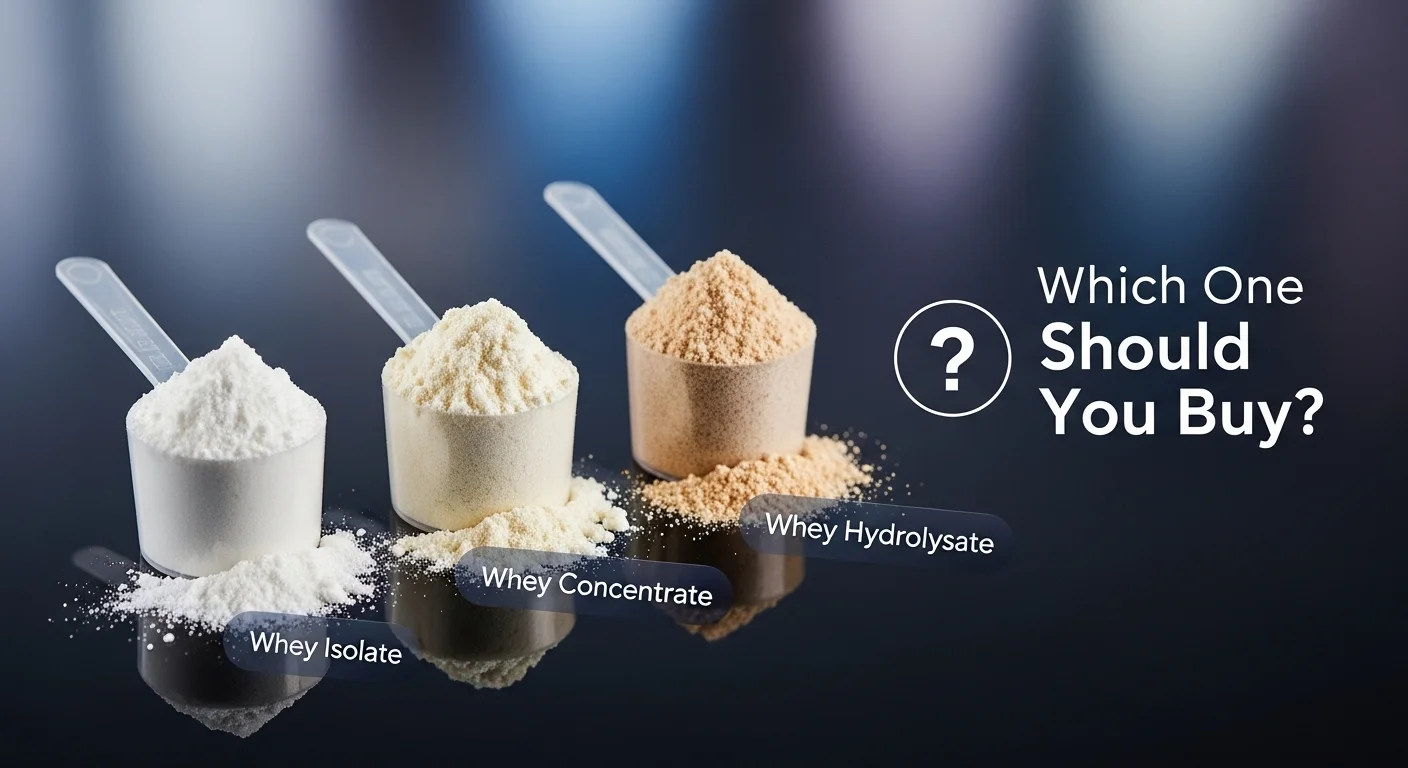
Walk into any supplement store in America and you will see three different types of whey protein: concentrate, isolate, and hydrolysate. The prices range from $30 for concentrate to $80 for hydrolysate, all promising to build muscle and speed recovery. Which one is actually worth your money?
Supplement companies have spent decades convincing you that the more expensive options are dramatically better. The truth is more nuanced. For most lifters, the differences are small enough that your choice should come down to three factors: your budget, your digestion, and your body composition goals.
This guide breaks down all three whey types — exactly what they are, how they differ, who each one is best for, and whether the premium versions are actually worth the extra money. No marketing hype, just the science.
The 10-Second Answer
Buy whey concentrate if: You are on a budget, tolerate dairy well, and want the most protein per dollar spent.
Buy whey isolate if: You are mildly lactose intolerant, want cleaner macros (less fat, fewer carbs), or are cutting calories.
Buy whey hydrolysate if: You have severe lactose intolerance, a very sensitive stomach, or money to burn.
That is the short version. Now let us get into why.
How Whey Protein Is Made
All three forms start from the same source: cow’s milk. Milk is about 80 percent casein and 20 percent whey (the liquid portion that separates during cheese-making). That whey gets filtered, dried, and processed into the different forms.
The main difference between concentrate, isolate, and hydrolysate is how much filtering and processing happens. More filtering = higher protein percentage by weight, less lactose and fat, and higher cost.
Whey Concentrate (WPC): The Basic Form
What It Is
Whey concentrate is the least processed form. The liquid whey goes through basic filtration that removes some water and lactose, then gets spray-dried into powder.
Typical nutrient profile:
- 70 to 80 percent protein by weight
- 3 to 8g lactose per 30g serving
- 2 to 3g fat per serving
- 4 to 7g carbohydrates per serving
- 20 to 25g protein per serving
Pros
- **Cheapest form** — typically 20 to 40 percent less than isolate
- **Retains natural compounds** — immunoglobulins, lactoferrin, and growth factors that get filtered out in isolate
- **Better taste** — the added fats and milk solids create a creamier, richer flavor
- **More satiating** — the fats and carbs slow digestion, keeping you full longer
- **More versatile for baking** — the fat content works better in protein pancakes and cookies
Cons
- **Higher lactose content** can cause bloating, gas, or diarrhea in sensitive people
- **More calories per gram of protein** — not ideal for strict cutting phases
- **Slightly slower absorption** than isolate (though this rarely matters in practice)
Best Whey Concentrates
- Nutricost Whey Concentrate ($40 for 5 lb)
- Optimum Nutrition Gold Standard (uses concentrate blend)
- Myprotein Impact Whey Protein
- BSN Syntha-6
Whey Isolate (WPI): The Cleaner Option
What It Is
Whey isolate goes through additional filtration — usually cross-flow microfiltration or ion exchange — to remove more lactose, fat, and carbohydrates. The result is a higher-protein, lower-everything-else powder.
Typical nutrient profile:
- 90+ percent protein by weight
- Less than 1g lactose per 30g serving
- 0 to 1g fat per serving
- 0 to 2g carbohydrates per serving
- 25 to 28g protein per serving
Pros
- **Near-zero lactose** — safe for most lactose-sensitive individuals
- **Minimal fat and carbs** — excellent for cutting phases
- **Higher protein per scoop** — more protein in fewer calories
- **Faster absorption** — may spike amino acids slightly quicker
- **Mixes cleaner** in water without clumping
Cons
- **More expensive** — typically $1.50 to $2.50 per serving
- **Some natural nutrients filtered out** — loses some immunoglobulins and growth factors
- **Thinner texture** — less creamy than concentrate, especially mixed with water
- **Less effective for baking** — the lack of fat affects texture in recipes
Best Whey Isolates
- Transparent Labs 100% Grass-Fed Whey Isolate
- Legion Whey+
- Momentous Whey Protein Isolate
- Thorne Whey Protein Isolate
- Raw Nutrition Bum Itholate
Whey Hydrolysate (WPH): The Premium Option
What It Is
Whey hydrolysate is whey protein (usually isolate) that has been partially pre-digested through a process called hydrolysis. The process uses heat, acid, or enzymes to break apart the long protein chains into smaller peptides. Think of it as protein that has already been “chewed” for your body.
Typical nutrient profile:
- 90+ percent protein by weight
- Lactose-free or very near zero
- Minimal fat
- 20 to 25g protein per serving
Pros
- **Fastest absorption** — broken peptides reach your bloodstream quickest
- **Easiest on digestion** — least likely to cause bloating, gas, or discomfort
- **Least allergenic** — pre-digestion reduces allergenic potential
- **Excellent for sensitive individuals** — people with IBS or food sensitivities often tolerate it
Cons
- **Most expensive** — can cost $2.50 to $4 per serving
- **Bitter taste** — harder to mask with flavoring
- **Marginal real-world benefit** — the faster absorption rarely translates to measurable muscle gains
- **Limited availability** — fewer brands offer true hydrolysate
The Honest Truth About Hydrolysate
Supplement companies love selling hydrolysate because the margins are higher. Marketing claims often emphasize “faster absorption” and “superior bioavailability.” Here is what the research actually shows, per sources like XWERKS and independent sports nutrition literature:
- Whey already has 96+ percent bioavailability — meaning 96+ percent of the protein gets absorbed
- The absorption speed difference between isolate and hydrolysate is minutes, not hours
- No conclusive studies demonstrate that hydrolysate builds more muscle than isolate in healthy individuals
For 95 percent of lifters, hydrolysate is not worth the premium. It shines only for people with specific digestive issues or elite athletes optimizing every marginal gain.
Best Whey Hydrolysates
- Optimum Nutrition Platinum Hydrowhey
- Dymatize ISO100 (technically isolate + hydrolysate blend)
- Nutrabio Grass Fed Whey Protein Isolate + Hydrolysate
Side-by-Side Comparison
Protein percentage by weight: Concentrate 70-80% | Isolate 90%+ | Hydrolysate 90%+
Lactose content: Concentrate 3-8g | Isolate <1g | Hydrolysate near zero
Fat content: Concentrate 2-3g | Isolate 0-1g | Hydrolysate near zero
Cost per serving: Concentrate $0.50-$1.00 | Isolate $1.50-$2.50 | Hydrolysate $2.50-$4.00
Absorption speed: Concentrate 1-2 hours | Isolate 1-1.5 hours | Hydrolysate 45-60 minutes
Best for: Concentrate = budget/taste | Isolate = lactose sensitivity/cutting | Hydrolysate = severe digestion issues
Which Whey Type Is Right for YOU?
Pick Whey Concentrate If…
- You are on a budget
- You tolerate dairy without issues
- You are bulking or maintaining weight
- You like creamy, rich protein shakes
- You bake with protein powder regularly
- You are a first-time buyer unsure of what works for you
Pick Whey Isolate If…
- You are mildly lactose intolerant
- You are cutting calories or tracking macros strictly
- You experience bloating with concentrate
- You want the cleanest macros per serving
- You prioritize mixability over taste
- You can afford the premium
Pick Whey Hydrolysate If…
- You have severe lactose intolerance or dairy allergies
- You experience digestive issues with isolate
- You have IBS or other gastrointestinal conditions
- You are a competitive athlete optimizing every variable
- You have the budget and specific medical reasons to justify it
The Verdict on Blends
Many popular products — including Optimum Nutrition Gold Standard and BSN Syntha-6 — use whey blends (typically concentrate + isolate, sometimes with hydrolysate added). These blends attempt to combine the cost benefits of concentrate with the purity of isolate.
Pros of blends:
- Balanced price point
- Better taste than pure isolate
- Lower lactose than pure concentrate
Cons of blends:
- Some brands use tiny amounts of isolate purely for marketing
- Hard to know exact ratios if the label is not transparent
Honest take: A quality blend like ON Gold Standard is a great all-around pick for most lifters. You get a reasonable mix of value, taste, and macro profile.
The Amino Acid Spiking Warning
Here is something the industry does not want you to know. Some cheap whey proteins are “amino acid spiked” — meaning they add cheap amino acids like taurine, glycine, and creatine to inflate the nitrogen content that protein testing measures. The label says 25g protein per serving, but the actual complete protein might be 15g.
How to spot and avoid amino acid spiking:
- Look for **Informed Protein certification** — third-party testing that verifies protein content accuracy
- Check if the label lists **added free-form amino acids** (taurine, glycine, creatine)
- Be skeptical of very low prices — if the math does not work for quality whey, it probably is not quality whey
- Stick with reputable brands that disclose their amino acid profile transparently
Brands like Transparent Labs, Raw Nutrition, and Momentous are explicitly Informed Protein Certified, which is the best defense against amino acid spiking.
Frequently Asked Questions
Q: Is whey isolate really better for muscle building than concentrate?
A: Not in any meaningful way. If you hit your daily protein target, the type matters very little for muscle growth. Pick based on digestion and budget.
Q: Can I use whey concentrate if I am lactose intolerant?
A: Maybe. Mild lactose intolerance may tolerate concentrate, but isolate or hydrolysate is safer. Start with a small serving and see how you feel.
Q: Why is my protein shake causing gas and bloating?
A: Likely lactose content (if using concentrate) or artificial sweeteners. Try switching to isolate, eliminating sucralose, or adding digestive enzymes.
Q: Is grass-fed whey worth the extra money?
A: Marginally better nutritional profile (slightly more omega-3s and CLA), better ethically, but the performance difference is minimal. A matter of values, not results.
Q: Can I mix whey concentrate and isolate?
A: Absolutely. Many commercial blends do this. You can also layer scoops yourself to find your preferred balance of cost and purity.
Q: Does whey hydrolysate cause faster muscle growth?
A: No research conclusively shows this. The faster absorption is real but the practical muscle-building difference is negligible for most lifters.
Final Thoughts
Whey concentrate, isolate, and hydrolysate are not really competing products — they serve different needs. Your choice should come down to three questions: How is your digestion? What is your budget? What are your body composition goals?
For most lifters: A quality whey concentrate or blend gives you 95 percent of the benefit at 60 percent of the cost. Optimum Nutrition Gold Standard has been the standard for 25 years for good reason.
For lactose-sensitive lifters: Whey isolate is worth the premium.
For rare cases with severe digestive issues: Hydrolysate earns its place.
But no matter which type you pick, the fundamentals remain the same. You need enough total daily protein. You need consistent training. You need adequate sleep. The whey type is the cherry on top, not the cake itself.
Keep following MyBodyKarma for more honest supplement breakdowns and fitness guides.